Tuesday, November 22, 2011

Master Food Preserver Course

I think that most people know about the Master Gardener program organized by Cooperative Extension offices around the country. It's a great program: serious gardeners get training in a wide variety of horticultural topics and then share that knowledge with their community through a mandatory number of volunteer hours in the year after the course.

Well, now Humboldt County Cooperative Extension is offering a Master Food Preserver course! You read that correctly. Coop Extension will be teaching a nine-week course starting February 4th and running every Saturday from 9 to 3pm through March 31st. The course will cover jam and jelly making; drying; canning; pickling; freezing; and food safety.

Once students are awarded their graduation certificates, they are required to provide 40 hours of volunteer service teaching preservation skills to the community. Although the letter to potential applicants states that these hours must be performed in Humboldt County, I've spoken with Deborah Giraud and she would be thrilled to have some Del Norte folks do volunteer service right here.

If you're interested in applying for this wonderful learning opportunity, you can find more information and the application forms here. Let us know if you plan to attend -- maybe we can help set up a Del Norte car-pool for the classes!

Thursday, November 10, 2011

Thanksgiving And The Economy

At a time when many people are already struggling financially, Thanksgiving dinner is expected to cost 13% more than it did last year. Commodity prices have gone up, raising prices in the store on everything from bread to flour to cranberries. And, of course, the main feature on many Thanksgiving tables: the turkey.

Soon Ray's and Safeway will begin their Fall Food Drives. Each store has put together a bag of groceries worth $20 that shoppers can buy for $15 and donate to CAN. Our food bank will get the food onto tables throughout our community that would otherwise look a little bare on November 24th. Please give generously so that everyone in our community has a comforting meal to be thankful for this Thanksgiving.

Friday, November 4, 2011

Local Food As Insurance

In today's New York Times, food writer Mark Bittman discusses the benefits of locally- and regionally-grown food. He writes about similar issues often, but today's column hones in on the policies that create more incentives for growing commodities (wheat, corn, soy) that we export, feed to livestock, or feed to automobiles than incentives for growing fruits and vegetables, for which we are a net importer. He quite rightly points out that our current agricultural system, requiring massive transport costs to bring "fresh" fruits and vegetables to our supermarkets without regard for seasonality, depends on a continuation of cheap fossil fuels. 

He writes, "We’ve seen that nothing is guaranteed: not energy, not water, not the financial system, not even the climate. Our food supply isn’t guaranteed either (remember 2008?), but it’s more likely to provide us with security if we focus more on regional agriculture and less on trade." 

As it happens, there is a living, breathing example of what happens to a food system dependent on imports and fossil fuels when those things disappear. When the Soviet Union collapsed, so did Cuba's food economy, which had relied heavily on sugar exports to nations behind the Iron Curtain, and imports of staple grains, tractors, and petroleum-based fertilizers and fuels. With no fuel coming in and no lucrative markets for its sugar, Cuba's food production was forced to become small, labor-intensive, and local. Human labor replaced tractors and small urban gardens and farms replaced sugar plantations almost overnight. You can read about it here, here, and here. 

Obviously, there are many criticisms that can be made of Cuba and it's Soviet-era economy is not one that is widely shared by nations today. But the lessons learned by Cuban citizens when they needed to take food matters into their own hands are valuable for us all. There are good reasons to build (or rebuild) local and regional food economies, and Cuba has shown the world that it is possible. Just some food for thought. 

Wednesday, November 2, 2011

New Feature On School Menus

Here at Growing Tables, we're all involved in the Building Healthy Communities work in our community. Part of the work is building resident power and bringing people together who have similar interests and passions to create community change. Sometimes, people get discouraged in working toward change because change can be hard. It can be uncomfortable and people in power can feel threatened and close themselves off to new possibilities.

But sometimes, everything works. Here's an example:

Several weeks ago, my husband was frustrated when looking at the monthly menu of school lunches. We eat a mostly vegetarian diet, with a little fish thrown in occasionally, and there were some school meals that were ambiguous: is a piazza pizza vegetarian or does it have sausage or pepperoni on it? Are the beans in the bean and cheese burrito vegetarian or are they made with lard?

Our kindergartener desperately wanted to check off hot lunch on her sign-in sheet some mornings, but all we could safely allow was the mac-and-cheese once a month. So my husband searched the school district's website and sent off an email asking for more information and ended up having a fairly lengthy and positive exchange with Judy Wangerin, the head of food services at the district. She agreed to try to find some solutions.

And she and her team did! This month's menu includes a single box explaining a new feature of the school menus: meatless meals are marked with an asterisk.


Note the message in the first Monday of the lunch menu!

This is community change at its easiest and best. One resident saw a problem that affected something he really cared about: his (our) daughter's lunches. He figured out who had the power to fix the problem, communicated with them and explained the problem, and the problem was fixed, the system was changed.

Now this particular system change might not affect very many people, but the lesson does:

If you see something in our community that you feel should be changed, say something! Figure out who can make that change happen and talk to them. Let them know you think a change is needed. If nobody speaks up, nothing will change. Be a part of the solution!

Thursday, October 20, 2011

Food Day Films And Celebration


The first annual Food Day is coming up on Monday, October 24th! Maybe you're celebrating by putting in a winter garden or cooking an all-local meal or savoring a meal at one of our local restaurants. If you don't yet have plans -- or even if you do! -- please join us for a celebration of Food Day through film and community.

Starting at 5:30, the Community Food Council for Del Norte and Adjacent Tribal Lands and Community Assistance Network will be hosting a Food Day event at the Del Norte School District Office at 301 Washington Blvd. We will celebrate the newly-elected Food Council representatives with a half-hour mixer with food and drinks. At 6pm, we will show a collection of short documentary films highlighting various parts of our food system from farm to waste stream. They are thought-provoking, funny, and inspiring. I hope you'll join the viewing and a post-film conversation.

Friday, September 30, 2011

Community Gardening Excitement


If you haven't seen today's Triplicate yet, make a point to pick it up. A beautiful above-the-fold photograph of one of our community gardeners opens a great article about the Elk Valley Community Garden. The predominantly Hmong gardeners at Elk Valley have turned a bare lot into an extremely productive piece of agricultural land over the past four and a half months. Looking at the garden, it's hard to believe that they only started planting seeds in mid-May! (Check out our past post about this garden to see the before pictures!) This garden supplies fresh, healthy food to 24 families, representing over 100 people. It's a small part of our population, but what a beautiful first step they've taken.

This excellent coverage by Kelley and Bry is the topper on a month of great community gardening in Del Norte. With five community members returning from NYC's American Community Gardening Association conference at the end of August, we have been inundated with information and excitement from their experiences. You can read about it here and here. At this month's Community Food Council meeting, we had two of our school Nutrition in the Garden educators tell members about the status, joys, and challenges in our school gardens. From there, eight people have formed a new subcommittee (open to all community members!) to find news ways to build support for all of our school and community gardens.


Last week, we shared a wonderful day of learning and collaboration with community gardeners from all over California and southern Oregon, right here in Crescent City. Ten sessions about gardening and community gardens took place at the beautiful Oceanfront Lodge. Forty-five participants learned about raised bed techniques, aquaponics, gardening with kids, incorporating fruit trees into community gardens, and much more. Above, Joe Gillespie talks about lessons learned during his 18 years of gardening at Crescent Elk Middle School. Below, participants show off their color-matched finds during a gardening with kids hands-on activity.

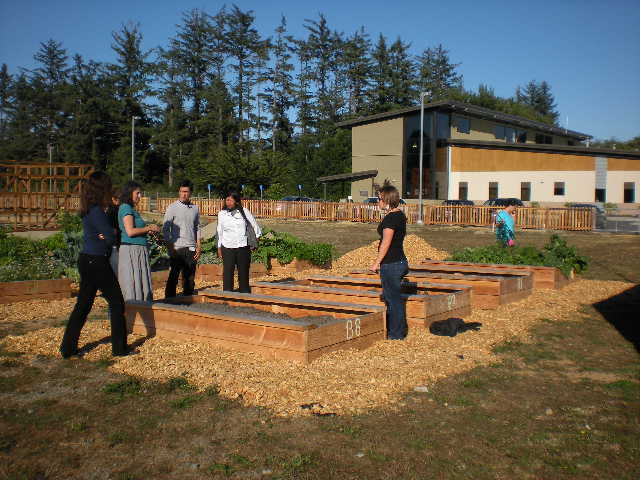
After a delicious lunch courtesy of the Bar-O Boys Ranch culinary arts program and exciting afternoon sessions, attendees toured our local community gardens and met with our gardeners. They toured six gardens and learned something new at each one.

 At the Seventh Day Adventist Community Garden

The new garden at the Wellness Center

When the tour was complete, a large contingent of our out-of-town guests had a laughter-filled dinner overlooking the Harbor at Good Harvest. They had more chances to ask questions and share information about their own community garden projects. People left Del Norte with new tools for their own communities. They loved our coast and our redwoods. They raved about the meals and our community's hospitality. It was Del Norte at its best: sharing one of the things we do well in one of the most beautiful places on our planet. Our gardens are an inspiration for people just starting out. They show what our community can accomplish when we work together and we were very proud to show off our gardeners' successes! Community gardens are about food, community, relationships, and hope for the future. All of that was on full display for 45 very happy conference-goers last Friday.

Thursday, September 8, 2011

ACGA Conference in New York City (cont.)

This week we have our co-worker and friend, Chad Hegelmeyer, doing a guest-post about his experience at the ACGA Conference in New York.  Chad is an Americorps VISTA, working as a coordinator for the Healthy Klamath Coalition, and a member of the team to rejuvenate the Klamath Glen Community Garden.  He was a welcome addition on the trip to New York, and we can't wait to see the progress at the Klamath Garden that Chad will help usher in after attending the conference.  Thanks, Chad!

Sometimes it’s a little embarrassing to talk about my previous experience in community gardening, mostly because my “previous experience” is limited to:
a.       occasionally watering a basil plant my mom bought for the kitchen of my college apartment to give it “a homier feel” (as if) and
b.      helping Angela Glore and Connor Caldwell in the Klamath Community Garden for a couple hours (during which time Angela asked me to get her a lettuce start, paused briefly, and then added, “You do know which one is lettuce, don’t you?”).

So when my job as a VISTA at Klamath River Early College of the Redwoods suddenly included building capacity for the community garden in the Klamath Glen, I felt a little under-qualified for the task. Fortunately, professional development is never difficult to come by in the BHC and VISTA worlds; Angela Glore came to my rescue by asking me if I would go, along with Connor and some folks from Open Door Clinic, to a four-day-long conference of the American Community Gardening Association in New York City. I responded in the words of Sid, the diabolical villain from Toy Story: “Double prizes!”

                                                           
My enthusiasm quickly waned, though. On the first morning of the conference, I woke up late and sore after spending the night on a too-short cot wedged between Connor’s bed and the TV because our hotel had been overbooked the night before. My mood continued to sour. It was mercilessly hot and humid in Manhattan. I briefly checked the conference schedule online and was met with beautiful photos of lush, green New York gardens with happy, smiling gardeners and community members standing in them. The difference between those gardens and what I saw in the Glen seemed like an insurmountable distance.

Walking down into the subway was like entering a sauna. After a short, but stifling, trip to 116th and Broadway, we climbed the stairs out of the station and found ourselves standing in the middle of a bustling farmers market (or, as they are called in New York, “a green market”) right on the street in front of the Columbia University auditorium where the conference was being held. We walked between vegetable stands, fruit stands, fresh cheese and dairy products, homemade organic jams, and freshly baked bread. We sampled incredible garden tomatoes, sweet plums, cheese sold by a pushy Mennonite, and literally the most delicious apple I’ve ever tasted. I was enjoying myself, but part of me still had this nagging frustration. In New York, it all seemed so easy and effortless. It reminded me of an episode of RadioLab we had listened to in Connor’s car while driving to the Medford airport the day before. The episode discussed some research that suggests that cities are actually more efficient—use less water and electricity and create less waste per capita—than sparsely populated areas. It seemed like the evidence supporting that theory was now hawking fresh, green cucumbers right before my eyes. New York was some kind of urban utopia where you could have your farmers markets, school and community gardens, and urban farms wherever and whenever you chose, and it was all a cinch to pull off.

Prior to the conference, I had been thinking a lot about the dichotomy between urban and rural. In my job, I see the distinction practically everywhere I look. In my capacity as a VISTA for the Building Healthy Communities initiative, I can’t help but notice that most of the other thirteen communities supported by the California Endowment are densely populated urban areas. As the “Klamath Promise Neighborhood Coordinator” (my official title), I’ve read then- Senator Obama’s speech about the Harlem Children’s Zone a hundred times and each time get a little twinge at the fact that its title is “Changing the Odds for Urban America” (I added the italics). After a few weeks of intense thought about this, I was beginning to feel a little stressed out about the subject—hence my grumpiness in New York. Somehow, after all of that thinking and reading, I had begun to consider the urban/rural dichotomy in terms of other opposite pairs like easy/difficult, efficient/messy, rich in resources/constantly lacking necessary resources. I had fallen into the classic “grass is always greener” conundrum, failing to see the reality of the similarities and differences between inner-city urban areas and isolated rural ones.


The reality check came Friday and Saturday when I spent one full day in various workshops and seminars led by real community gardeners and another full day touring gardens in the South Bronx. My first seminar on Friday morning was a case study on a school garden in Florida titled “A Tropical Oasis behind Barbed Wire.” Contrary to its saccharine title, the seminar was led by a man with long, wavy blonde hair and a permanent scowl through which he expounded primarily on the funding difficulties and arguments with administration inevitably forced upon people unfortunate enough to run school gardens. This seemed more in line with my pessimistic attitude, and I nodded knowingly at each of his complaints like a school gardening veteran.

The next day I boarded a bus headed to the Bronx with Breanne Sorrells and fifteen other conference-goers. Our first stop was the Jacqueline Denise Davis Garden, a small community garden, gazebo, and greenhouse shadowed by tall brick apartment buildings on the corner of Boston Road and E 165th Street. An employee from GrowNYC (a community gardening non-profit) and the neighborhood gardener who lived across the street gave us a rundown of the garden’s history. “How many volunteers do you have?” asked a conference-goer. The gardener responded that they had about ten regular volunteers, but had trouble recruiting and retaining more than that.


We continued to visit three more gardens in the Bronx that were maintained by community members and schools. Some had compost issues. Others had problems with vandalism. In another, a disagreement arose between two gardeners about how and when to harvest a certain type of pea.  I’m not sure why it took a four day conference to help me understand this, but my ultimate realization was that community gardening can be (and often will be) hard work. In the long run, there are no short cuts. There are no easy fixes. No matter where you live or what resources you have access to, the job of teaching people about growing food and nutritious eating is challenging. Food may be a commonplace thing in the U.S. (for some of us at least), but despite this, our relationship with food and eating is anything but simple. The reward of community gardening is that, unlike a lot of the other work that I do on a daily basis, I get to see the tangible fruits of my (limited) labor in person: the complex tang of a fresh tomato, nutrient-rich dirt under my nails, the smirk of a student volunteer who is secretly enjoying her work in the garden despite earlier claims to the contrary. The best things are always worth working for.

In the end, it’s good to know that Del Norte County has something in common with New York.