Food Day's four-word tagline is Healthy, Sustainable, Affordable, Fair. We're doing a series of blog posts leading up to Food Day (October 24th!) about what each of those words mean.
In my last post, I talked about what FAIR means in terms of our food system. Today, I'm combining a short discussion of SUSTAINABLE with something new I learned this morning. So what does a sustainable food system look like?
Wikipedia provides this definition of sustainable farming: "an integrated plant and animal production practices having a site-specific application that will last over the long term." The blog, Sustainable Table, defines it as follows:
"In simplest terms, sustainable is the production of food, fiber, or other plant or animal products using farming techniques that protect the environment, public health, human communities, and animal welfare. This form of agriculture enables us to produce healthful food without compromising future generations' ability to do the same."
It can be hard to know exactly what won't compromise future production, but there are some agricultural practices that clearly will. What comes to mind most clearly for me are the crop circles I sometimes see from airplanes. I'm not talking about alien crop art, but of irrigated perfect circles of green amid an otherwise brown landscape.
This National Geographic photograph of Nevada is a perfect example. Water pumped from underground aquifers is sprayed by a moving radius-irrigation system to produce perfectly green circles in the midst of a desert. Aquifers tend to replenish very slowly, so removing lots of water for irrigation like this is most definitely not sustainable. I think many people would look at a feedlot or CAFO (Concentrated Animal Feeding Operation) and also think, unsustainable.
So much of our industrial agricultural system relies on practices like these, so how do we move away from them towards systems that resemble the definitions of sustainable farming?
Well, this morning, I learned of a fast-food chain that is taking large steps in that direction. I knew that Chipotle Mexican Grill talks up its commitment to healthier foods, but I didn't know much about what they meant by that. Then I saw a link to this article about why Big Ag "hates" Chipotle and watched the animated short movie the article is about. The Scarecrow shows a bleak future agriculture and a simple Scarecrow who moves to defy it. After watching it, I needed to learn more about why Chipotle would make a film that could be quite controversial, so I went to their website.
It turns out Chipotle has an entire section of their website devoted to their Food With Integrity beliefs. According to Chipotle, they have been working towards better sourcing for their foods for over a decade, including sourcing 40% of their beans from organic sources, all of their dairy from cows not treated with rGBH, and most of their beef and chicken from farmers who do not use antibiotics in animal feed. They also have new initiatives to increase their local food purchases and use a 350-mile radius to define local. You can learn much more about their Food With Integrity standards on their website.
I don't eat much fast food ever, but sometimes when traveling, there are few options. I'm glad to know that there are better options even in the fast food category.
Better, that is, in terms of sustainability. This is definitely not an endorsement of Chipotle on all levels. I did a quick calorie calculation for a chicken burrito with brown rice and black beans. I included cheese and guacamole, but not sour cream, and it came to a grand total of 1,095 calories (about half a day's worth) and a whopping 2,960mg of sodium (more than the recommended daily intake). There are certainly ways to eat healthier at Chipotle (the vegetarian burrito bowl I've eaten clocks in at 615 calories on the calcultor), but I don't think the chain overall would get an A-plus for that first word in the Food Day tagline: Healthy.
Friday, October 4, 2013
Healthy. SUSTAINABLE. Affordable. Fair. (Part II)
Labels:
fast food,
Food Day,
nutrition,
restaurants,
sustainability
Wednesday, September 25, 2013
Healthy. Sustainable. Affordable. FAIR. (Part I)
I may have mentioned this already, but in case you missed it, October 24th marks the third annual Food Day, organized nationally by the Center for Science in the Public Interest. The four-word tagline for Food Day is "Healthy. Sustainable. Affordable. Fair." It will be on our local Food Day posters this year, and I wanted to write a little bit about what each of those words mean in terms of our food system.
(As it happens, this tagline has some of the same themes as the official Mission of the Community Food Council for DNATL: "The Community Food Council for Del Norte and Adjacent Tribal Lands will build a vibrant, sustainable local food system through opportunity, education, innovation, advocacy, and promotion.")
This blog post will look at what it means for a food system to be FAIR.
A lot of people might automatically think of the Fair Trade labels that show up on coffee, chocolate, and other imported products. Fair Trade USA describes Fair Trade this way: "Fair Trade goods are just that. Fair. From far-away farms to your shopping cart, products that bear our logo come from farmers and workers who are justly compensated."
There are a lot of debates right now about what constitutes "just compensation". Minimum wage laws in many states, including California, are raising the minimum wage significantly above the federal minimum wage, and the Obama administration is asking Congress to raise the federal minimum wage to $9.00/hour. One of the arguments for this is that a person working full-time at the current federal minimum wage ($7.25/hour) would still fall below the federal poverty line for a two or three person household. So all those working single parents? If they make the minimum, their family lives in poverty.
But in many parts of our food system, the situation is much worse. Federal minimum wage for farm workers can fall below even the federal minimum wage if they are paid by the "piece". Piece work means that pickers are paid for every crate or box of produce picked. For example, the going rate for orange pickers in Florida is 85 cents per 90 pound box. An average harvest rate for a worker is 64 boxes in an 8-hour shift, equivalent to 5,760 pounds of oranges, and yet the hourly rate works out to just $6.80/hour.
Picking almost 6,000 pounds of fruit in 8 hours is back-breaking work, and fruit picking is not as "unskilled" as many people believe. I've picked both apples and persimmons on a commercial scale and it's not fun. Persimmons, particularly, like many other softer fruit, take a light hand to avoid bruising. In my case, I was also expected to make split-second decisions about whether each individual fruit was export or domestic quality. And yet farm workers are paid so poorly that a full third of farm worker families live below the poverty line. (This is made much worse due to the seasonal nature of much farm work, of course, because workers may not be able to find full-time work year round.)
So what about the rest of the supply chain? It doesn't get a lot prettier as you move through the slaughterhouses, processing plants, and food service industries.
Consider the front of house in food service as an example. Tipped workers (think wait staff in restaurants) can make as little as $2.13/hour (the federal minimum cash payment). Most states (but not all) have at least slightly higher minimums for tipped workers, but many are still under $3.00/hour. Now, the theory is that these workers will make at least minimum wage once their tips are factored in and this probably works for wait staff at higher-end restaurants where a bill for two people could be 50 dollars or much more. But what about diners and other inexpensive restaurants? If you walk in and order the $2.99 breakfast special, how much are you leaving as a tip? Will the collective tips on inexpensive meals raise that $2.13/hour to a livable wage? (And this leaves out the fact that many wait staff have to "tip out" to busboys and sometimes kitchen staff who do not otherwise benefit from tips.)
I haven't even mentioned farmers and how little of the price of a loaf of bread or box of cereal goes to the person who grew the grain, but trust me, it's not a lot.
So, FAIR. For our food system to be fair, the producers in the system would need to earn a decent (not extravagant, but decent) living for working full-time in jobs that are almost always physically demanding. All consumers would need to have equal access to healthy foods, no matter where they live and how much they make (I'll write more about this when I discuss AFFORDABLE).
That's my opinion, of course, and yours may differ. Please join the conversation in our comments section.
Labels:
agriculture,
food justice,
food policy,
restaurants
Monday, September 23, 2013
How Healthy Is Your Diet?
The folks over at the Food Day website have devised a 14 question quiz designed to show how healthy your diet is for you, the planet, and the animals. I have a few issues with the quiz. They don't, for example, ask if you produce any of your own food or how much of your food is locally-produced, which could have a fairly significant impact on the environmental footprint of your diet. Aside from a few other quibbles with their methodology, though, I think the quiz is a great starting point for a conversation about the health consequences of our food choices.
I got a solid A when I took the quiz, but that's not too surprising since I eat an overwhelmingly vegetarian diet. I answered that I eat fish once a week, but it's really more like once a month. Given that the quiz takes the environment and animal welfare into consideration, I was almost guaranteed an A.
My vegetarian diet is mostly about the environment, not animal welfare. I do love animals and certainly became a vegetarian in high school because of my concern for animals. But when I became an outdoor educator in college, it became clear that the environmental toll of industrial meat production is a more important reason to avoid meat. Many people, from Paul McCartney to a former chief economist at the World Bank to the United Nations, have called for people to reduce meat consumption and move toward a vegetarian diet in order to mitigate against climate change. I am not militant about vegetarianism (obviously, since some fish sneak into my mouth occasionally), but I do think it's important to talk about the connection between eating meat and the environment.
I worked for a summer as the head cook at an environmental summer camp run by the New York State Department of Environmental Conservation. I quickly learned that my coworkers were hard-core meat-eaters who demanded meat at every meal. It was disheartening, given that most of them were environmental studies majors in college and planned to stay in environmental education as a career. It was a frustrating summer. The last straw for me was when two of them were complaining about waking up in their tent on federal (probably BLM) land out west and finding cattle surrounding their tent. Even after I pointed out that those cattle were certainly beef cattle, not dairy, they could not see the connection between their desire for meat at every breakfast, lunch, and dinner, and the grazing of cattle on federal lands.
There are consequences to our food choices beyond our personal health and well-being. Take the quiz and share your score (if you'd like) in our comments section. Let's start this conversation!
Wednesday, September 18, 2013
Back Home On The Redwood Coast
Last year, my family and I left the beautiful Del Norte coast for parts east, driving out 199 the day before all the Food Day festivities started at the fairgrounds. After participating in many weeks of planning, I missed all those events as we drove through Great Basin National Park, traveled the "Loneliest Highway", visited old friends in St. Louis, and finally arrived in our new home state just as Hurricane Sandy smacked the whole region with devastating winds and flooding.
It was not the welcome to your new home we were anticipating.
Things didn't work out as planned, despite the wonderful proximity to parts of my extended family and my hometown. When I was offered the blandly-titled, but absolutely wonderful Food Systems Analyst position and my husband was told he'd be welcomed back to the parks here, the decision to come back wasn't all that tough. We will miss friends and family in the east, but I think we learned that we are all Westerners now.
I'm in my third week on the job now and in the midst of planning 2013's Food Day celebrations (see our dedicated Food Day posts here). There have been good and bad changes since we left town. Wild Rivers Market opened in their expanded space shortly after we left, but Ray's closed their stores in Crescent City and Smith River.
Everywhere I've gone over the past three weeks, I've been welcomed back with open arms. It's hard to move a family across the country, but much easier when you're coming back to friends and the Redwood Coast.
We're going to be bringing the Growing Tables blog and our Community Food Council Facebook page back to life over the next several weeks. We want to be a place everyone can come to learn about food events, resources, and people. Keep checking back!
It was not the welcome to your new home we were anticipating.
Things didn't work out as planned, despite the wonderful proximity to parts of my extended family and my hometown. When I was offered the blandly-titled, but absolutely wonderful Food Systems Analyst position and my husband was told he'd be welcomed back to the parks here, the decision to come back wasn't all that tough. We will miss friends and family in the east, but I think we learned that we are all Westerners now.
I'm in my third week on the job now and in the midst of planning 2013's Food Day celebrations (see our dedicated Food Day posts here). There have been good and bad changes since we left town. Wild Rivers Market opened in their expanded space shortly after we left, but Ray's closed their stores in Crescent City and Smith River.
Everywhere I've gone over the past three weeks, I've been welcomed back with open arms. It's hard to move a family across the country, but much easier when you're coming back to friends and the Redwood Coast.
We're going to be bringing the Growing Tables blog and our Community Food Council Facebook page back to life over the next several weeks. We want to be a place everyone can come to learn about food events, resources, and people. Keep checking back!
Labels:
community events,
food events,
Redwood Coast
Thursday, April 4, 2013
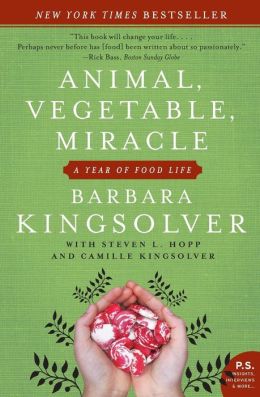
"Animal, Vegetable, Miracle"
"Animal Vegetable Miracle," by Barbara Kingslover, tells the story of a family who commit themselves to eating locally for a full year. They move to a piece of farm land they own in Southern Appalachia, and start to live off the land. The rule was they could only eat food they grew themselves, or that they could purchase locally. There were a couple exceptions, but for the most part, everything was local.
One of the things this book focuses on is the importance of buying food in season. It's a way of eating that has nearly disappeared from our lifestyle. Certain foods grow at certain times of they year, which is when they are meant to be eaten. I've become so accustomed to seeing the same fruits and vegetables in the supermarket each week that I had nearly forgotten this. The great thing about eating produce in season is it lets you know that it is in it's freshest and most nutritious state. It can also help you to understand what food is grown locally and it allows you to avoid food shipped from thousands of miles away.
A particular part of the book I liked were the recipes. Every few chapters, it gave a set of recipes they used for that particular season, based on what food was available. There were some great recipes in there, which showed how creative the family could get with the ingredients on hand in their house. Instead of limiting them to certain recipes, eating locally seemed to enhance their choices. It allowed them to make things they may have never made before. Also, making dinner each night from scratch seemed to bring their family together in a way that could not be achieved otherwise, as everyone got to play a role in the process.
It was interesting to read how the family's outlook toward this year changed. At first, it seemed like a bit of a challenge, giving up some of the foods they enjoyed and were accustomed to. However, without realizing it, it just became a part of their lives. By the end of the book, Kingslover even said there was no countdown to the end of this year. In fact, they did not even keep track. As the time went by, this way of eating became important to them and ingrained into their lifestyles.
"Animal, Vegetable, Miracle" is an inspiring book about our relationship to food. It shows how much more we appreciate the things we eat when we grow it ourselves and support our neighbors.
Thursday, March 28, 2013
Wheat Germ: A Quick Nutritonal Boost

Wheat germ is one of those foods you can add to anything to give it an extra nutritional boost. Unfortunately, it is something missing from the majority of people's diets, particularly those who eat a large percentage of highly processed foods.
There are 3 parts of a wheat kernel: the bran, the germ, and the endosperm. The bran is the outer layer full of fiber. In the center, is the endosperm, which provides carbohydrates , and in the inner, is the germ, which is the main source of nutrients. Since the germ has healthy oils that can go rancid after sitting too long, it is removed in the process of making white flour. This allows flour to be able to sit on the shelf for a much longer period of time. Unfortunately, this also means that all that good nutrition is completely stripped away, leaving a substance with little nutritional value.
So what nutrients are in wheat germ? One of the most important nutrients it contains is Vitamin E. This is a fat soluble vitamin, that has antioxidant protection and protects your body from the harm of free radicals. Free radicals harm the body by damaging cells and causes numerous chronic diseases. Many people are deficient in Vitamin E because of the processing of so many foods, and eating wheat germ is a great, natural way , to incorporate it into your diet without other supplements.
Besides vitamin E, wheat germ is great source of B-vitamins, fiber, healthy fatty acids, and minerals such as iron, zinc, magnesium, calcium, selenium, and manganese.
The good news is wheat germ is an easy thing to add into your daily meals. Here is list of a few ideas:
1. Sprinkle it over your cereal or oatmeal in the morning
2. Use it as a substitute for breadcrumbs in a recipe
3. Add it into yogurt as an alternative to granola
4. Combine with flour when making baked goods
5. Sprinkle it into batters used for waffles/pancakes
6. Toss it in with a bowl of pasta/chili/stew
Adding some wheat germ to your diet is a great way help you get necessary nutrients that you would not get otherwise. There are no quick fixes to a unhealthy lifestyle, but wheat germ may be the next best thing.
Friday, February 22, 2013
Community Food Council Update
The Community Food Council for Del Norte and Adjacent Tribal Lands had a retreat the beginning of February to determine what projects they wanted to focus on in the coming year. After a packed day with a lot of brainstorming they narrowed their ideas to 3 main projects:
Tribal Fishery: With this project, the Council hopes to connect with the tribes in Klamath, and to expand local fish sells in Crescent City. There is a program called Fish for Elders the tribe does, and the goal is to expand this to the neighboring communities. Next steps involve making a lot of phone calls and doing some research around fish numbers and river issues. The subcommittee leading this has already begun the process of making phone calls to Tribal Leaders and the Fishery Department.
Local Market Conversion: This project has two main goals: To make more fresh fruits and vegetables available in stores and to develop a Del Norte Local Brand. To get stores to carry more fresh, healthy food the Council plans on utilizing the California Endowments Freshworks Fund. This subcommittee has begun approaching local store owners to see who is interested in this. As far as the brand, creating a Del Norte Locally Made Logo aims to create a sense of pride in the community, and to encourage stores to carry local items. Steps to do this involve researching “Buy Fresh, Buy Local,” defining local guidelines, designing the brand, seeking approval, and doing PR.
Community Education Series: The third project is being planned as a series of classes to educate the community about food and gardening. This subcommittee is in the process of developing the class schedule and a time frame of classes. Possible classes include: Beginning gardening, Intermediate gardening, Cooking with real food, and Canning/preserving/seed saving. These classes will aim to develop people's skills and encourage them to live healthier lives.
Tribal Fishery: With this project, the Council hopes to connect with the tribes in Klamath, and to expand local fish sells in Crescent City. There is a program called Fish for Elders the tribe does, and the goal is to expand this to the neighboring communities. Next steps involve making a lot of phone calls and doing some research around fish numbers and river issues. The subcommittee leading this has already begun the process of making phone calls to Tribal Leaders and the Fishery Department.
Local Market Conversion: This project has two main goals: To make more fresh fruits and vegetables available in stores and to develop a Del Norte Local Brand. To get stores to carry more fresh, healthy food the Council plans on utilizing the California Endowments Freshworks Fund. This subcommittee has begun approaching local store owners to see who is interested in this. As far as the brand, creating a Del Norte Locally Made Logo aims to create a sense of pride in the community, and to encourage stores to carry local items. Steps to do this involve researching “Buy Fresh, Buy Local,” defining local guidelines, designing the brand, seeking approval, and doing PR.
Community Education Series: The third project is being planned as a series of classes to educate the community about food and gardening. This subcommittee is in the process of developing the class schedule and a time frame of classes. Possible classes include: Beginning gardening, Intermediate gardening, Cooking with real food, and Canning/preserving/seed saving. These classes will aim to develop people's skills and encourage them to live healthier lives.
If anyone is interested in helping out with any of these
projects, please email foodcouncildnatl@gmail.com.
Our next Food Council meeting is Monday, March 18th at the RHS
conference room at 5:00pm. Everyone is welcome!
Subscribe to:
Posts (Atom)